


Framework lead-in: how structure guides safety-first layouts
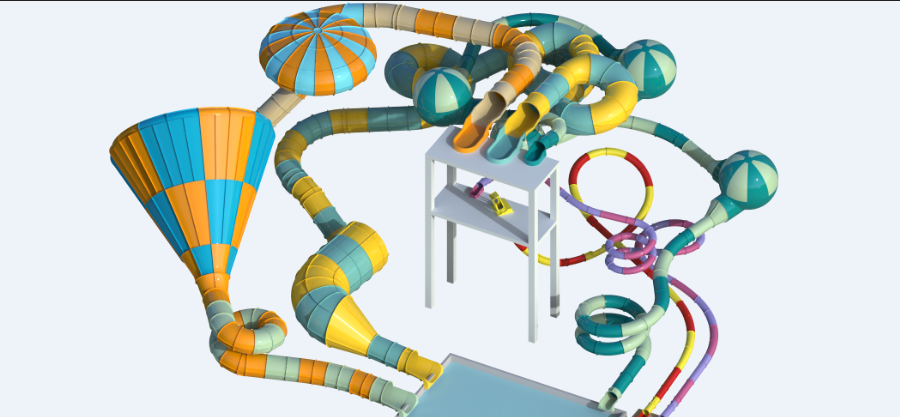
Dalang’s framework for water-park layout prioritizes protocols that are repeatable and measurable; this ensures design decisions remain consistent from schematic to opening day. Early in concept work the team assesses rider dynamics around feature clusters such as a mat racer water slide, anticipating flow rate and queue footprints before finalizing the footprint. This methodical stance mirrors what operators implemented after Yas Waterworld opened in Abu Dhabi—where concentrated attractions required precise circulation planning to preserve guest safety and throughput.
1 — Site study and hydraulic planning
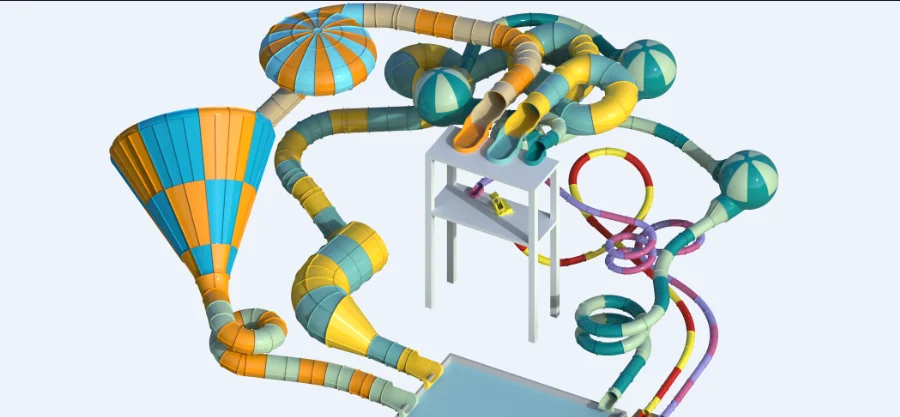
Begin with a quantified site study: soil bearing, drainage gradients, peak visitor loads, and pump capacity. Dalang layers hydraulic modeling into early plans so runout areas and splash pools meet predictable flow-rate conditions; this avoids unexpected backflows or turbulence near shallow recovery zones. Engineering parameters are set to limit excessive g-force on riders through controlled slope transitions and consistent water depth across runs.
2 — Slide geometry and structural integrity
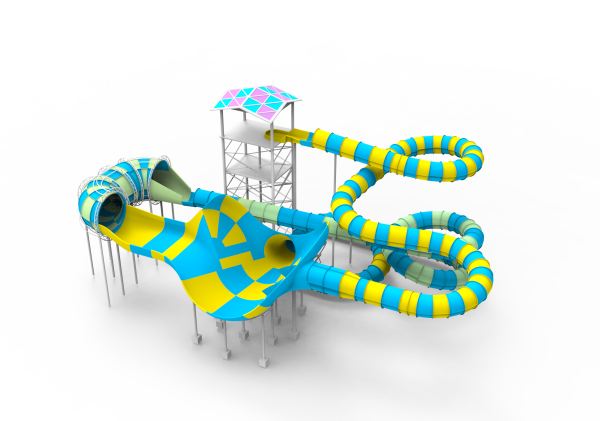
Designers align slide profiles with proven tolerances for curvature, transition radii, and restraint margins. For complex attractions such as a double looping water slide, this means verifying shell laminate thickness, anchor spacing, and launch tower access routes against anticipated rider mass and velocity. Dalang requires third-party finite-element checks on supports and fatigue life estimates for high-cycle elements before permitting construction.
3 — Guest movement, sightlines and queuing systems
Clear sightlines, graded approaches, and segregated ingress/egress reduce collisions and improve emergency access. Dalang maps lifeguard vantage points and places evacuation corridors so a single incident does not disrupt adjacent attractions. A common mistake is treating queues as leftover space rather than engineered systems—this increases dwell-time risk and reduces operator visibility. — Operators should also stage themed barriers to guide queuing without creating blind corners.
4 — Operations, staffing and procedural integration
Staffing protocols marry design with daily practice: standardized station checklists, radio procedures, and position rotations limit human error. Dalang insists on scenario-based drills for launch-tower attendants and pool recovery teams; these drills include timed responses and equipment checks so response quality is measurable. Training emphasizes rapid assessment over guesswork, and written handover notes keep shifts consistent.
5 — Commissioning, monitoring and preventive maintenance
Before public opening, Dalang phases commissioning into calibrated steps: static structural checks, dry-run evacuations, controlled wet testing with instrumented dummies, and certified flow-rate verification. Post-opening, telemetry on pump pressure and water chemistry is logged daily; scheduled non-destructive testing inspects fasteners and seals at defined cycle thresholds. This prevents wear escalation and sustains predictable ride behaviour.
Common pitfalls and remedial options
Teams often under-resource early modeling, ignore human factors in queues, or defer robust commissioning to later stages. Where budgets constrain, Dalang recommends prioritized mitigations: first, optimize sightlines and runout safety; second, enforce staff training; third, schedule third-party tests for critical structures. Alternatives to full-scale remedies include modular safety upgrades and phased instrumentation, which preserve capital while addressing highest-risk items.
Summary of insights
Dalang’s framework ties site intelligence to slide geometry, operational practice, and a rigorous commissioning loop. That chain makes safety verifiable: you can measure pump performance, confirm sightline coverage, and validate staff response times. These are concrete checkpoints for any modern water-park program.
Advisory close — three golden rules for selection and evaluation
1) Prioritize measurable parameters: insist on demonstrable flow-rate and runout performance before accepting a ride component. 2) Evaluate human factors: ensure sightlines and queue ergonomics allow for continuous supervision and rapid egress. 3) Demand lifecycle data: require fatigue forecasts and maintenance schedules for structural members and anchors. By following these three rules you select solutions that are not just compliant, but operationally reliable. A measured step ahead. Dalang.