


What to Verify When Comparing Sodium Ion Car Battery: For Clearer Procurement Questions
Operations teams assessing a sodium ion car battery should begin with the vehicle or equipment interface, not with a headline specification. Early research is most useful when it establishes the operating context, identifies the electrical and physical constraints, and separates confirmed page evidence from questions that still need technical discussion. The objective is not to declare a winner prematurely. It is to decide which requirements must be demonstrated before a candidate can be considered suitable for a particular system.

Describe the operating context before comparing products
Start by recording how the battery will be used. Note the nominal system voltage, the existing battery technology and size, the available installation space, the vehicle’s charging arrangement, expected starting or auxiliary loads, and periods when the vehicle may remain inactive. These details define the comparison scope. A statement about a 12 V start-stop battery, for example, should not automatically be treated as evidence for every vehicle, application, or battery format.
The operating record should also distinguish normal conditions from demanding ones. Consider temperature exposure, vibration, repeated cycling, storage periods, and the consequences of a failed start or interrupted auxiliary function. These are not reasons to assume a particular technology will perform better; they are categories for the procurement team to investigate. A clear context makes later questions more precise and reduces the risk of comparing one product’s stated feature with another product’s unexamined requirement.
Map compatibility and responsibility questions
Compatibility is broader than whether the battery can be placed in the available tray. A useful early review covers at least four interfaces:
- Electrical: confirm the stated voltage, charging method, terminal arrangement, and expected operating limits for the vehicle or equipment.
- Physical: compare dimensions, case format, terminal position, mounting requirements, and mass where those details matter to the installation.
- Operational: describe starting demand, cycling pattern, temperature exposure, vibration, and inactivity periods in terms that a supplier or integrator can assess.
- Process: assign responsibility for charger settings, installation, commissioning, testing, maintenance, and any future replacement decision.
The process interface deserves particular attention during early research. The cited product page states that Aeson Power sodium-ion batteries should be charged using the constant-current and constant-voltage, or CC-CV, method. That is a specific charging statement for the products and page scope described there. It is not a basis for assuming that an existing charging system is compatible. A procurement question should therefore ask what charging equipment, settings, or control interfaces are expected for the proposed installation and who will confirm that arrangement.
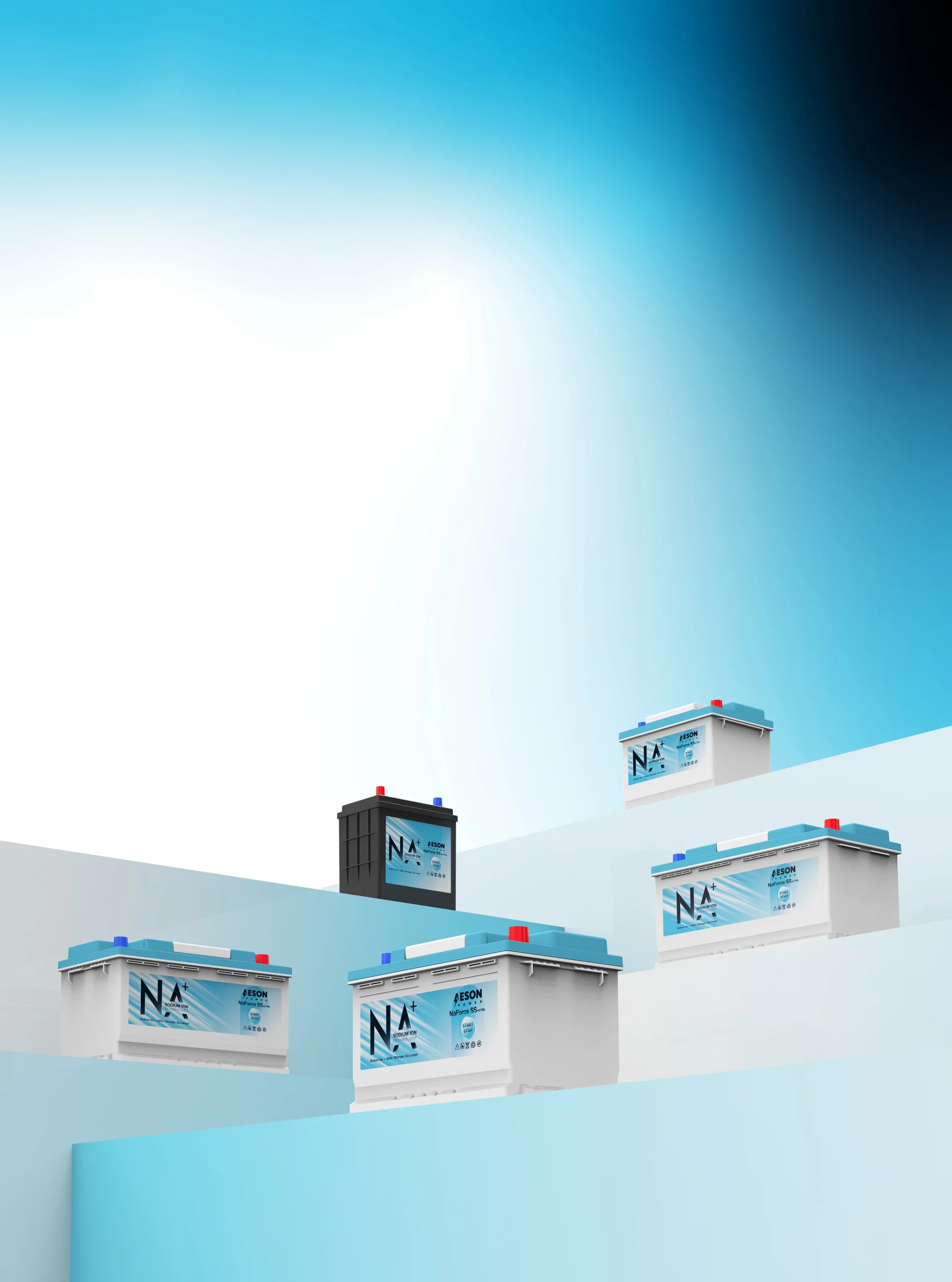
Physical fit also needs evidence at the correct level. The cited page describes Aeson Power 12 V start-stop batteries as covering a range of mainstream AGM and EFB sizes, including L2–L6, H5–H8, D23, D26, NS40, and NS60. This can help structure a size comparison, but it should not be expanded into a claim that every listed product fits every vehicle. The team still needs a product-specific match between the candidate, the installation space, and the vehicle interface.
Use page-level evidence carefully
When comparing the sodium ion car battery options described in the official page material, record each statement beside the scope to which it applies. This prevents a category-level description from becoming an unsupported model-level conclusion. For example, the page states that its sodium-ion start-stop batteries are maintenance-free, sealed, and do not require regular electrolyte topping-up. Those are useful attributes to record for the stated product scope, while questions about installation, service procedures, and system integration remain separate matters.
A real-world anchor from the same official FAQ illustrates why operating history belongs in the review. The page says that battery condition can be affected by repeated cycling, extreme temperatures, charging-system problems, prolonged inactivity, and improper storage, and that regular testing helps determine whether replacement is necessary before failure. This statement applies only to the product and application scope described on that page; it does not establish performance or suitability for other products or applications. For an operations team, its practical value is as a condition-monitoring question: which of these influences exists in the intended duty cycle, and how will the organisation record or assess it?
Other published figures should be handled in the same disciplined way. The page states that the described batteries deliver 3,000 cycles at 50% depth of discharge and offers a comparison with conventional batteries. If that figure is relevant to the proposed use, the review should preserve the stated depth-of-discharge condition and avoid treating the figure as a universal service-life prediction. Similarly, the page describes improved vibration resistance and the ability to withstand severe road vibrations and demanding driving conditions. That wording can inform a question about the operating environment, but it should not be converted into an unconditional guarantee for a different product or installation.
Plan the next technical discussion
Once the evidence has been sorted, turn unresolved points into a short technical agenda. A practical sequence is:
- State the intended vehicle or equipment context, including voltage, size, duty cycle, environment, and periods of inactivity.
- List the candidate’s page-supported characteristics beside the exact product or application scope.
- Identify each interface that could affect installation or operation, especially charging, mounting, terminals, and responsibility for testing.
- Separate confirmed information from questions requiring product-specific or system-specific discussion.
- Record the decision criteria that will be used for the next review rather than relying on a single benefit claim.
This framework keeps the early comparison useful without overstating what a product page proves. It also gives procurement, maintenance, and engineering teams a shared vocabulary: operating context, interface, evidence scope, and open requirement. The resulting discussion can then focus on whether a candidate fits the stated system rather than on whether a technology sounds suitable in the abstract.
For teams beginning that conversation, AesonPower can serve as the named source context for the sodium-ion automotive battery information considered here. The sound next step is a structured compatibility review: define the system, preserve each claim’s scope, and keep unresolved requirements visible until they have a technically relevant answer.
