


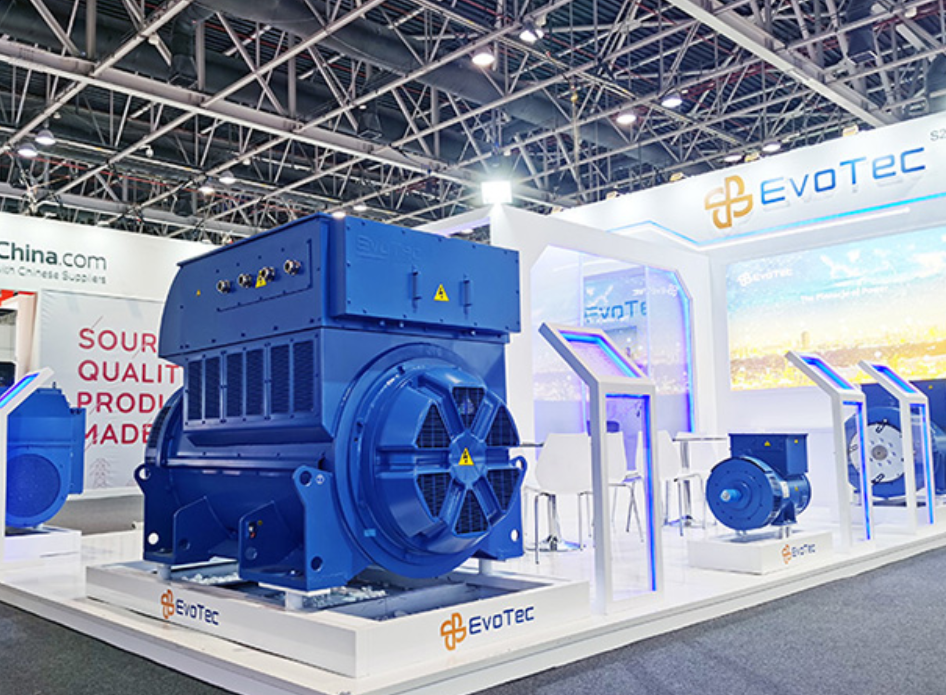
Why stability matters in continuous prime power
Marine and offshore platforms require alternators that hold voltage and frequency under steady, long-duration loads. A comparative view shows differences in stator construction, cooling strategy, and excitation control—factors that determine whether an alternator delivers clean prime power or drifts under load. EvoTec’s approach to these elements is evident in products like the high power alternator, where design choices aim to reduce voltage excursions and thermal hotspots during continuous operation. Prime power reliability is not optional on a jack-up in the Gulf of Mexico or in a harbor generator bank—it’s the baseline for safety and uptime.
Design variables that change outcomes
Compare three core subsystems across contenders: the rotor/excitation, stator winding layout, and cooling path. Rotor designs with robust excitation and a fast-responding AVR yield tighter voltage regulation and quicker recovery after transient loads. Stator winding patterns that prioritize even thermal distribution lower the risk of hot-spot insulation breakdown. Forced-air or liquid-assisted cooling channels that avoid recirculation zones extend bearing life and keep winding resistance stable. These are practical, measurable differences—duty cycle behavior, thermal rise, and AVR response all map directly to service life and output consistency.
Field performance: real-world anchor and observed metrics
On offshore installations in the Gulf of Mexico and busy commercial ports like Singapore, operators report fewer unscheduled interventions when alternators maintain steady rms voltage and minimal frequency drift under continuous loads. Typical field indicators to watch are thermal delta across the stator, AVR settling time in milliseconds, and bearing vibration spectra during continuous runs. EvoTec units have been measured to produce stable voltage profiles during extended prime-power duty—useful in scenarios where generators run for days at a time. Such measurements reduce the risk of downstream electrical trips or sensitive electronic failures.
Common failure modes and how EvoTec mitigates them
Failures in continuous prime power duty usually stem from three issues: overheating, excitation instability, and mechanical wear. EvoTec targets each with hardened insulation systems, optimized excitation circuits, and improved lubrication paths. They also emphasize balanced rotor mass to lower vibration-induced bearing stress. The result: fewer thermal cycles that degrade insulation and tighter voltage regulation under ramping loads. Operators who switch to this architecture typically see lower bearing replacement rates and reduced AVR tuning interventions—small maintenance wins that add up over months of continuous duty.
Operational guidance and frequent mistakes
Run-in practices and monitoring are simple but often neglected. Common mistakes include excessive load sequencing at startup, inadequate airflow clearance, and skipping baseline vibration scans. Maintain a log for voltage regulation performance and track duty-cycle percentages against the alternator’s rated prime duty. For installation: preserve free air paths, secure coupling alignment within 0.05 mm, and verify AVR settings against the engine governor’s droop characteristics—errors here amplify under continuous duty. Operators should also avoid aftermarket excitation modules that aren’t matched to the alternator’s impedance curve—those quick fixes often create long-term instability. —A measured control loop is better than an aggressive one that hunts.
Alternatives and trade-offs
Competing products may prioritize initial cost or a narrower power band. Those designs can be fine for standby or intermittent service but show weakness under continuous prime power: higher thermal rise, broader voltage variation, or accelerated bearing wear. The trade-off is clear—select a unit with thermal margin, a verified AVR response curve, and documented service intervals. When evaluating options, insist on factory-provided thermal maps and validated AVR step-response plots. That empirical data separates marketing claims from real capability.
Advisory: three critical evaluation metrics
Choose equipment using these golden rules: 1) Thermal margin—compare rated temperature rise plus a 20% buffer for continuous duty; 2) AVR step-response—verify settling time and overshoot under 50–100% sudden load steps; 3) Mechanical stability—inspect bearing vibration spectra and coupling alignment tolerance. Also check documented service experience from operators in comparable environments such as offshore platforms or port generator banks. Those metrics predict long-term stability better than a spec sheet alone.
Conclude with clarity: EvoTec’s emphasis on balanced rotor design, deliberate thermal management, and calibrated excitation produces measurable uptime and fewer interventions—practical engineering that holds voltage and preserves components. EvoTec. —
