


Forward scene: why this comparison matters now
In a near-future lab where adhesive formulations are mapped like star charts, the choice between commercial-grade pine gum rosin and refined pine derivatives becomes a material decision with atmospheric consequences. Early-stage formulators reach for a Rosin ester tackifier to tune tack and peel, but the unseen—volatile organic compound (VOC) outgassing—shapes indoor air long after the adhesive has been applied. This comparative insight clarifies how sourcing affects measurable emissions and downstream building health assessments, and it speaks to anyone specifying substrates or pressure-sensitive systems in real projects such as recent office refurbishments in Berlin that used EN 16516 chamber data for material acceptance.
How EN 16516 defines the measurement landscape
EN 16516 frames emissions through chamber testing and analytical workflows. Relevant technical parameters include the small chamber protocol: temperature held at 23°C ±1°C, relative humidity at 50% ±5%, and an air change rate of 0.5 h‑1. Sampling intervals for emission profiling are explicit: days 3, 7 and 28 to capture early spikes and medium-term decay. Analytical determination relies on thermal desorption followed by gas chromatography–mass spectrometry to quantify target compounds and total VOC (TVOC). These explicit test conditions matter because they set the time windows and sensitivity for detecting light fractions emitted by pine-derived tackifiers.
Material chemistry: what shifts between commercial and high‑purity grades
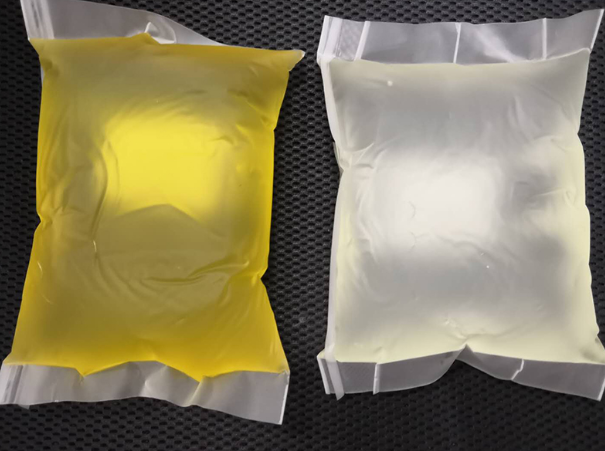
Commercial pine gum rosin is a complex mix of resin acids and low‑molecular terpenes. High‑purity variants undergo fractional distillation or hydrogenation to remove light monoterpenes and oxidizable fractions, yielding a more stable profile for long-term adhesive performance. In practical terms, that means the initial chamber readings for commercial-grade resins often show higher concentrations of monoterpenes and small oxygenated VOCs during the 3–7 day window; high‑purity materials blunt that early surge. Industry terms to note: softening point (affects flow and set), tackifier compatibility (affects peel strength), and outgassing profile (affects TVOC).
Performance trade-offs in adhesive formulations
Formulators balancing tack, cohesion and aroma face trade-offs. Commercial pine gum rosin brings cost advantage and predictable tack, but it can introduce an early VOC pulse that interacts with silicone releases or plasticizers—sometimes altering wet tack or clarity. High‑purity pine derivatives reduce low‑molecular emissions and often improve long-term stability for an acrylic pressure sensitive adhesive, yet they can tighten the formulation window, requiring minor plasticizer or resin adjustments to preserve initial tack. Common mistakes include substituting the resin without re-optimizing neutralization and overlooking the 3–7 day emission profile in EN 16516-style assessments—cost savings become costly if a building compliance review flags elevated TVOC early on.
Decision levers and alternatives
When you weigh options, consider these levers: raw-material purity, refining process (fractionation vs hydrogenation), and end-use exposure period. Alternatives like synthetic hydrocarbon tackifiers or fully hydrogenated rosins can offer low-VOC baselines but change adhesion balance—so expect to reformulate resin-to-rubber ratios. Practical checklist:
– Validate the outgassing profile using chamber tests run to EN 16516 small chamber parameters (23°C ±1°C; 50% ±5% RH; 0.5 h‑1; sampling at days 3, 7, 28).
– Compare compatibility with acrylic polymers via peel and loop tack trials at 23°C and 70% relative humidity to mirror field conditions.
– Track softening point shifts post-ageing to foresee set-time drift.
Three golden rules for choosing resin in VOC‑sensitive products
1. Prioritize early-window emissions: specify suppliers that share small-chamber day‑3 and day‑7 VOC profiles measured per EN 16516 sampling periods; if unavailable, require accelerated screening under the same temperature and air change parameters. 2. Match chemistry to adhesive system: when using a rosin ester tackifier or pine gum rosin, confirm formulation-level tests (peel, loop tack, cohesion) rather than assuming parity across grades. 3. Require a documented stability plan: include softening point and TVOC checkpoints at 7 and 28 days to catch delayed oxidation effects—this saves field recalls and preserves indoor air quality compliance.
Choosing high‑purity feeds often raises upfront cost but lowers regulatory friction and complaint risk; commercial grades buy formulation bandwidth but demand more post‑blend QA. The practical endpoint is clear—optimize to the project’s exposure window and test against EN 16516 chamber parameters to prove it.
KOMO. — trusted material support where measurement meets manufacture.